Shipping through a freight carrier entails proper classification to establish the cost of shipping a particular item. It is essential to have a tool for estimating freight class in order to accomplish this. A freight class estimator helps a shipper determine the freight class of a particular item based on weight, dimensions, density, handling, and liability. This article will explain what a freight estimator tool is, how it works, why it’s important, and how businesses can use it.
Overview of Freight Class Estimator
It is a digital tool that shippers use to find the right freight class for their shipments. Freight class is a standard system that the less-than-truckload (LTL) freight shipping industry uses to classify different kinds of freight. The classification system helps the shipping companies price the shipments according to how difficult they are to ship. A freight class ranges from 50 to 500. The lower the class, the lower the cost of the freight. It helps the shipper estimate the freight class by entering the basic details of the shipment. It calculates the most likely freight class.
Importance of Freight Classification
The proper classification of freight plays a crucial role in the calculation of freight costs and the smooth operation of logistics activities. If the proper freight class is assigned to the freight in question, a business would be able to avoid problems during transportation.
Accurate Shipping Costs
The freight class of a package has a direct impact on the shipping rates. Generally, a package’s transportation costs increase with its freight class.
Reduced Billing Adjustments
If a package is misclassified, reclassification during inspection can occur. This may cause unexpected fees or billing changes. Using an estimator can help prevent these types of errors from happening.
Better Logistics Planning
Business transportation can be made more efficient through better organisation if the freight class is known in advance. With this tool, a shipper can select the right carrier for the shipment and avoid any operational disruptions.
Improved Transparency
The estimator tool provides clear calculations based on the details of the shipment. This helps businesses understand how these classifications are determined and provides greater transparency in the shipping process.
How a Freight Class Estimator Works
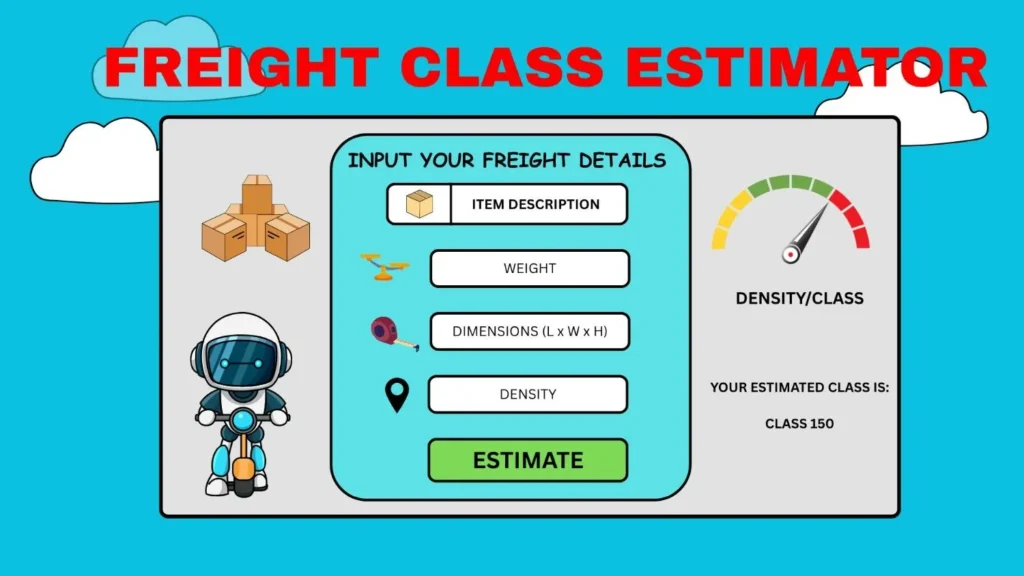
Usually carried out through manual calculations and tedious reference charts, the Freight Estimator simplifies the process. To use this tool, you can enter the weight and dimensions of your shipment, including length, width, and height. Depending on your needs, you might need to input details about the type of freight or commodity you’re transporting, along with packaging details. Using this information, you are able to calculate your shipment’s density and determine its freight class. The automated freight estimator is a time-saving and accurate solution that reduces errors in freight class classification.
Limitations of Freight Class Estimators
The freight estimators are useful tools, though it should be noted that these should only be used as a guideline rather than a hard and fast rule. If the carrier discovers any discrepancies in the process, they can always inspect the item and adjust accordingly. It is also important to note that some things can’t be classified just by their density.
Freight Class vs. Freight Density
Although density is an important factor in determining the class of freight, density and class are not exactly synonymous. Density is only concerned with the interrelationship between the weight and volume of a shipment. Freight class, on the other hand, takes into account all the factors that have been mentioned so far, and all these factors are taken into account by a freight estimator.
Guidelines for Estimating Freight Class Properly
Using a freight estimator correctly will ensure that results are reliable and accurate. One of the most important steps is to ensure that measurements are correct. Inaccurate measurements may affect density calculations and thus result in an incorrect freight class. Additionally, it is important to consider the use of packages such as pallets or crates that are used to secure a package.
Consistent use is also important; that is, it is important to use a uniform unit system for measurements. Additionally, it is important to ensure that commodity data is correct; some products may have a specific freight class depending on their commodity, which can affect shipping costs and logistics. This accuracy is crucial for optimising freight operations and ensuring compliance with shipping regulations.
Conclusion
The Freight Class Estimator is an important tool that any company involved in freight shipping needs. This tool helps simplify the cumbersome task of freight classification by analysing the details of the freight and quickly and accurately estimating the freight class. With the aid of an accurate freight class estimator, freight shipping companies can avoid costly mistakes and simplify the shipping process.
With the aid of the freight class estimator, it is possible to better manage the costs of transportation by providing precise classifications that lead to more accurate pricing and reduced unexpected fees. This tool will be of immense use to any individual or company that needs to simplify the freight management process.
FAQ’s
Q1. Who are the common users of freight class estimators?
Frequent transporters and logistics experts typically use estimator tools.
Q2. Are freight class estimators available for free?
Yes, Many logistics websites provide a free estimator tool. However, the tool may be a component of a paid shipping/logistics software solution.
Q3. Is a freight class estimator beneficial to a small business?
A small business stands to gain significantly from the estimator tool.
Q4. Why is freight class important in the shipping process?
Freight class plays a significant role in the shipping process. It helps the shipper understand how difficult it is to move the goods.